
When signals clash: How Garage@HTX guards against electromagnetic interference
In a world crowded with wireless signals, even the smallest clash can disrupt life-saving operations. Here's how HTX ensures Home Team systems stay resilient against invisible interference.
By Cara Yap | Published on 10 November 2025
SCROLL DOWN
You would think you’d stumbled onto the set of Stanley Kubrick’s 2001: A Space Odyssey, if not for the hulking Electric Pump Ladder (EPL) taking centre stage inside the cavernous chamber. Clad wall-to-ceiling with white tiles and foam pyramids, the space feels strangely muffled, like a vacuum that swallows sound.
The stillness is broken by the brisk, purposeful movements of engineers, who wheel a towering antenna mast into position around the fire-fighting vehicle. They then shuffle into an adjoining room, before high-frequency signals are silently blasted at the vehicle.
Inside the control room, the engineers track the exercise intently, eyes darting across screens alive with jagged lines and numbers. Their mission: to see if the vehicle can still perform flawlessly when bombarded with electromagnetic radiation (EMR).

The stillness is broken by the brisk, purposeful movements of engineers, who wheel a towering antenna mast into position around the fire-fighting vehicle. They then shuffle into an adjoining room, before high-frequency signals are silently blasted at the vehicle.
Inside the control room, the engineers track the exercise intently, eyes darting across screens alive with jagged lines and numbers. Their mission: to see if the vehicle can still perform flawlessly when bombarded with electromagnetic radiation (EMR).
Electromagnetic radiation (EMR) is the energy from electromagnetic fields. It travels in waves to carry signals, enabling wireless communication for everything from Wi-Fi to mobile networks and medical devices. In short, it basically lets information move through the air without wires.
As our world becomes more connected EMR grows in prevalence, elevating the risk of electromagnetic interference (EMI), whereby signals from one device disrupt the operation of another. Possible results? Equipment malfunctions and disrupted emergency systems.
“We’re using more and more electronic equipment, but the frequency spectrum is limited. The challenge is making sure all these devices can coexist without interfering with one another,” explained Ho Jia Xian, a Lead Engineer at HTX’s Robotics, Automation & Unmanned Systems (RAUS) Centre of Expertise (CoE).
The frequency spectrum maps how much of a signal's strength "lives" at each frequency. Think of it like lanes on a highway – each device or technology is allocated its own lane by authorities to send signals smoothly without crashing into others.
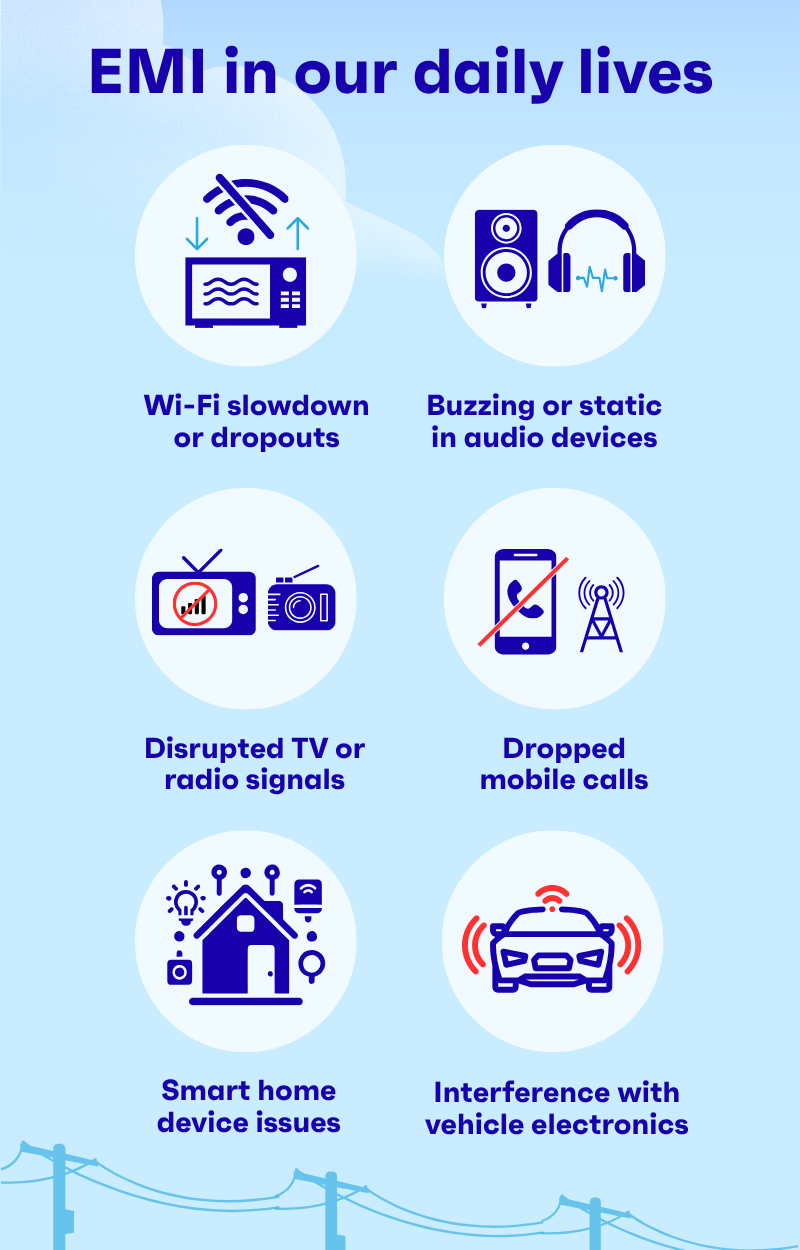
At other times, it may occur in barely noticeable ways, such as when a microwave oven operating near a Wi-Fi router causes the internet connection to slow or drop – since they use the same frequency band.
But the consequences could be more dire. Just imagine an EPL fitted with radios plus digital navigation systems and firefighting controls. With so many electronic devices operating simultaneously during an emergency, even the slightest EMI could disrupt critical coordination and response to save lives.
This is exactly why ensuring these systems work seamlessly together is absolutely critical.
“We’re using more and more electronic equipment, but the frequency spectrum is limited. The challenge is making sure all these devices can coexist without interfering with one another,” explained Ho Jia Xian, a Lead Engineer at HTX’s Robotics, Automation & Unmanned Systems (RAUS) Centre of Expertise (CoE).
The frequency spectrum maps how much of a signal's strength "lives" at each frequency. Think of it like lanes on a highway – each device or technology is allocated its own lane by authorities to send signals smoothly without crashing into others.
Have you encountered electromagnetic interference?
Chances are, you’ve felt the effects of EMI. For instance, it was previously linked to the loss of signalling communications on the MRT, leading to train service delays.At other times, it may occur in barely noticeable ways, such as when a microwave oven operating near a Wi-Fi router causes the internet connection to slow or drop – since they use the same frequency band.
(Infographic: HTX/Nicole Lim)
But the consequences could be more dire. Just imagine an EPL fitted with radios plus digital navigation systems and firefighting controls. With so many electronic devices operating simultaneously during an emergency, even the slightest EMI could disrupt critical coordination and response to save lives.
This is exactly why ensuring these systems work seamlessly together is absolutely critical.
Alongside these cases of incidental interference, is intentional EMR (IEMR), otherwise known as the deliberate generation of EMR by malicious actors to interfere with, disrupt or disable electronic systems.
“This is common in conflict zones such as Ukraine and Russia, where entire areas are sanitised of not only drone communications, but also cell phone, TV and radio broadcast signals,” shared Jia Xian.
The methods used range from broadband jamming, which overwhelms signals across a broad range of frequencies so devices cannot communicate, to precise attacks that confuse or block specific systems like GPS navigation or drone controls.
This can cause collateral disruption to civilian services.
“We ensure Home Team vehicles/systems don’t cause disruptions to everyday life/functions when deployed in public,” said Jia Xian.
While critical equipment such as police radios or emergency vehicle monitors are built to withstand EMI, HTX also runs electromagnetic compatibility (EMC) tests to make sure new devices installed on the same vehicle don’t disrupt one another.
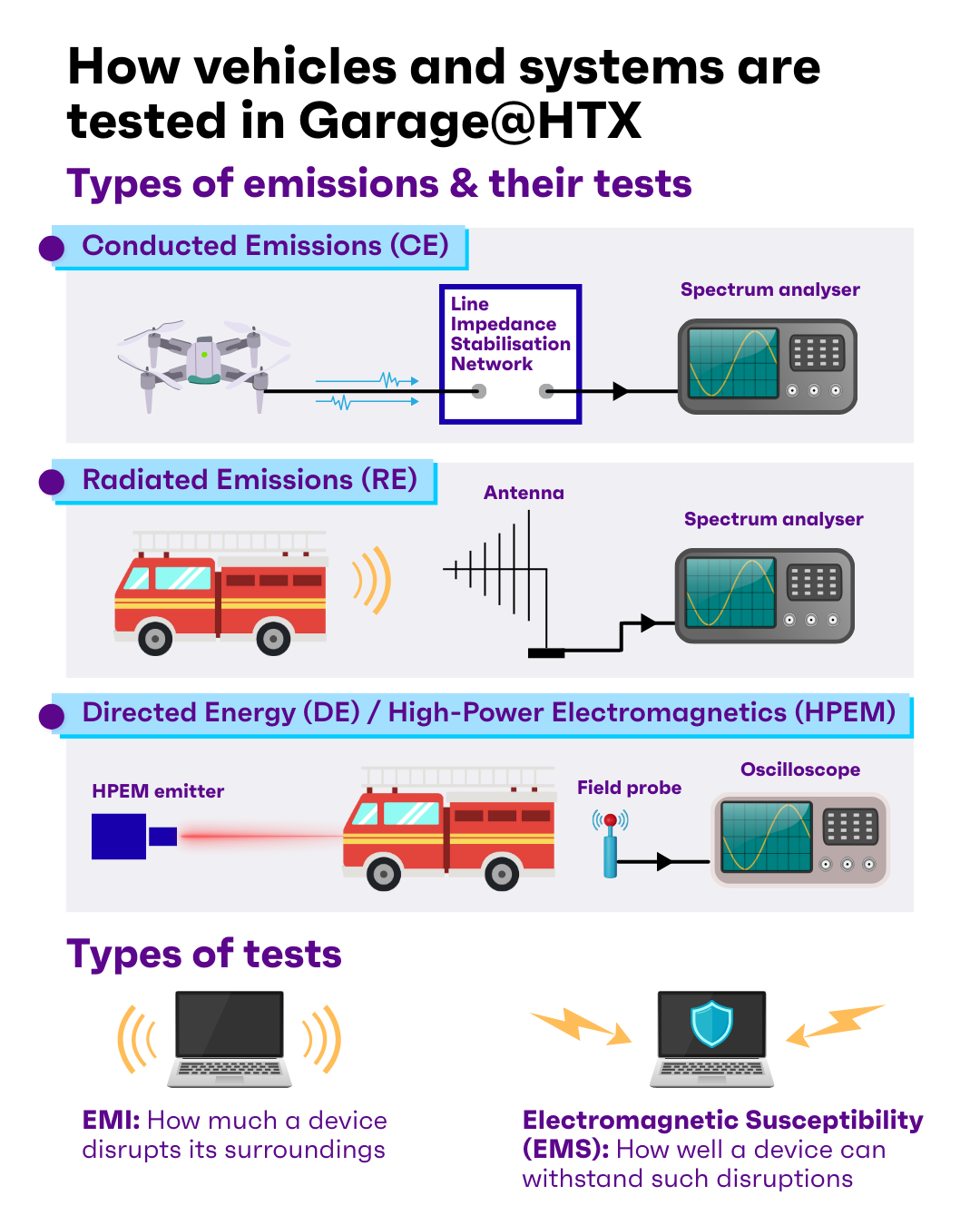
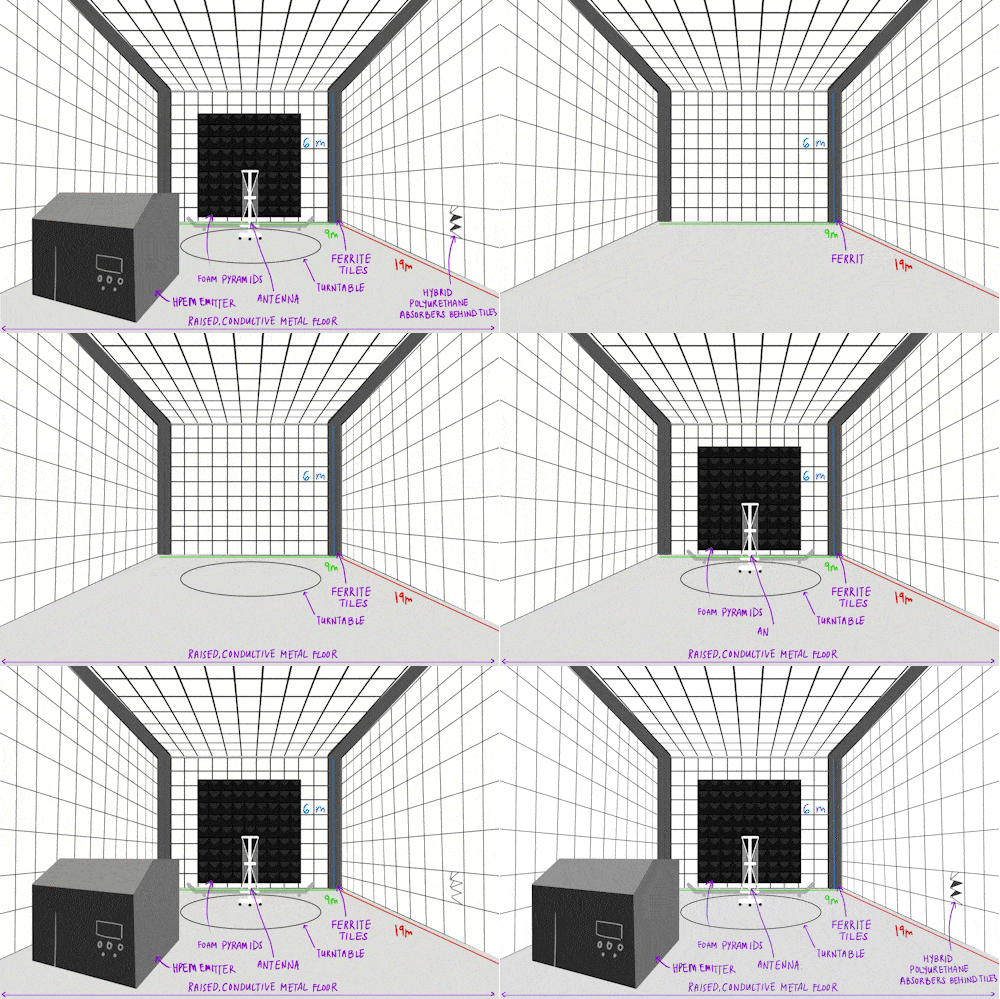
Taking pride of place at Garage@HTX is the 100 sq m semi-anechoic EMI/EMC test chamber designed to absorb electromagnetic waves. Here, engineers like Jia Xian run tests on everything from small drones to large vehicles such as the Singapore Civil Defence Force’s (SCDF’s) 8x2.5m EPL.
Home Team equipment is first tested before deployment to ensure it works without interference and can withstand external signals.
While EMI/EMC chambers aren’t new, having a dedicated facility allows controlled, repeatable testing of devices in realistic electromagnetic environments (EME), ensuring reliability without the time, cost and variability of outdoor testing.
It's the first such facility in Singapore to be equipped with an EME recording and replication system, which enables equipment like drones or radios to be tested in realistic radiofrequency (RF) conditions that replicate the mix of wireless signals present in real-world settings.
“We can subject Home Team mission-critical systems to ambient signals captured from a real site – like TV and communication signals – to determine if these systems can perform optimally in real-world conditions,” explained Jia Xian.
So, what happens when Home Team vehicles and systems fail the tests conducted in the chamber? This is where Garage@HTX’s engineering development zone for configuration and rapid prototyping comes into play.
Here, HTX engineers make fixes such as adding shielding to block stray signals, improving grounding to safely divert excess electrical currents, or installing filters to remove unwanted electrical noise.
Shielding involves the use of special materials like metal coatings, foils or mesh to block or contain electromagnetic energy emitted by devices.
.jpg?sfvrsn=622274d0_3/10-(2).jpg)
“This is common in conflict zones such as Ukraine and Russia, where entire areas are sanitised of not only drone communications, but also cell phone, TV and radio broadcast signals,” shared Jia Xian.
The methods used range from broadband jamming, which overwhelms signals across a broad range of frequencies so devices cannot communicate, to precise attacks that confuse or block specific systems like GPS navigation or drone controls.
This can cause collateral disruption to civilian services.
Garage@HTX: Built to ensure public safety
Thankfully, HTX is helping the Home Team stay ahead of such threats with Garage@HTX, the first purpose-built facility dedicated to engineering developmental testing and evaluation for public safety in Singapore.“We ensure Home Team vehicles/systems don’t cause disruptions to everyday life/functions when deployed in public,” said Jia Xian.
While critical equipment such as police radios or emergency vehicle monitors are built to withstand EMI, HTX also runs electromagnetic compatibility (EMC) tests to make sure new devices installed on the same vehicle don’t disrupt one another.
(Infographic: HTX/Nicole Lim)
Taking pride of place at Garage@HTX is the 100 sq m semi-anechoic EMI/EMC test chamber designed to absorb electromagnetic waves. Here, engineers like Jia Xian run tests on everything from small drones to large vehicles such as the Singapore Civil Defence Force’s (SCDF’s) 8x2.5m EPL.
Home Team equipment is first tested before deployment to ensure it works without interference and can withstand external signals.
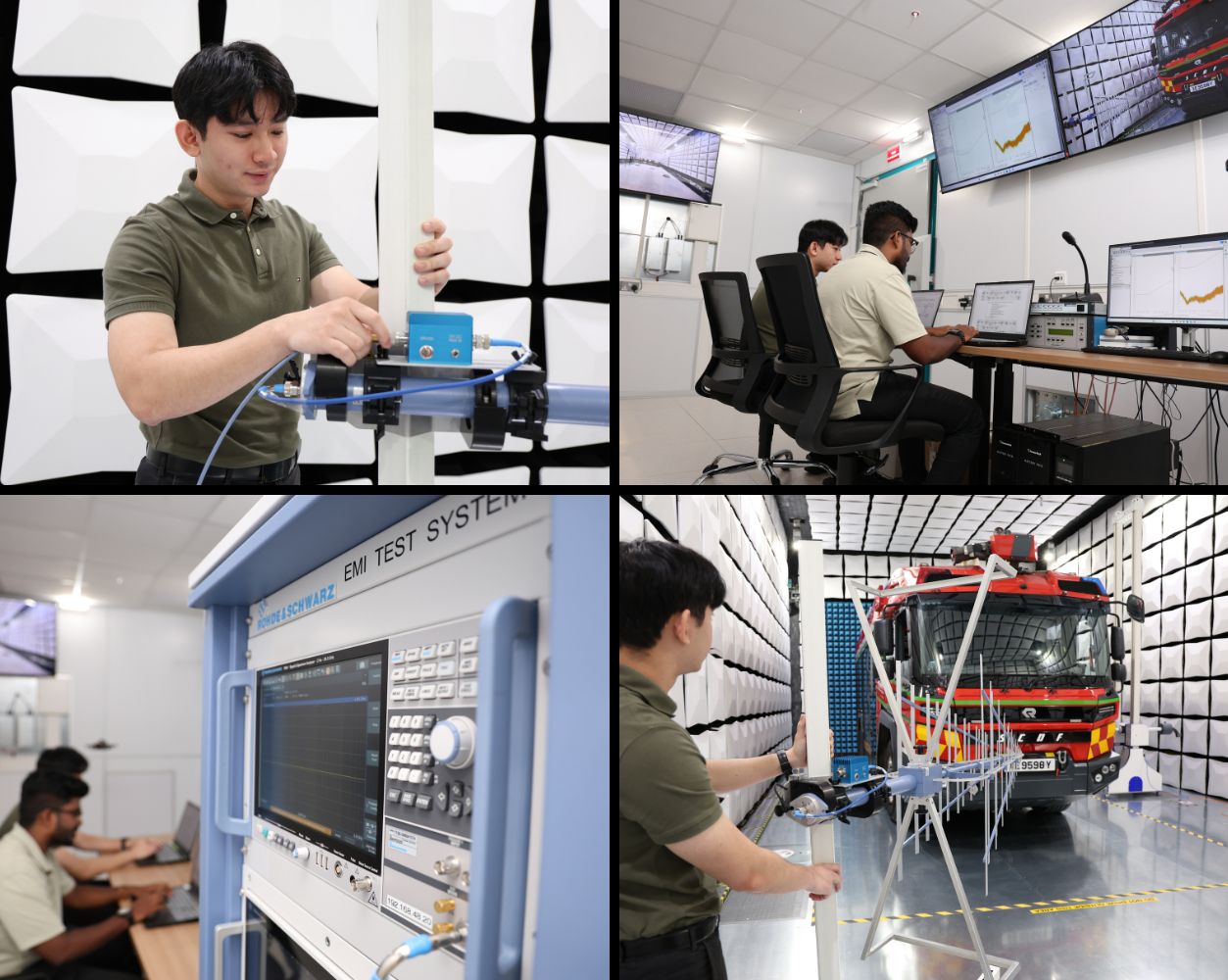
Clockwise from top left: HTX engineers test a variety of systems and equipment at Garage @HTX; engineers can view the EMI/EMC test chamber from the control room; the test chamber can accommodate an EPL; the control room is equipped with cutting-edge technology for measuring EMI. (Photos: HTX/Nicole Lim)
While EMI/EMC chambers aren’t new, having a dedicated facility allows controlled, repeatable testing of devices in realistic electromagnetic environments (EME), ensuring reliability without the time, cost and variability of outdoor testing.
It's the first such facility in Singapore to be equipped with an EME recording and replication system, which enables equipment like drones or radios to be tested in realistic radiofrequency (RF) conditions that replicate the mix of wireless signals present in real-world settings.
“We can subject Home Team mission-critical systems to ambient signals captured from a real site – like TV and communication signals – to determine if these systems can perform optimally in real-world conditions,” explained Jia Xian.
What’s inside the EMI/EMC chamber?
(Illustration: HTX/Nicole Lim)
So, what happens when Home Team vehicles and systems fail the tests conducted in the chamber? This is where Garage@HTX’s engineering development zone for configuration and rapid prototyping comes into play.
Here, HTX engineers make fixes such as adding shielding to block stray signals, improving grounding to safely divert excess electrical currents, or installing filters to remove unwanted electrical noise.
Shielding involves the use of special materials like metal coatings, foils or mesh to block or contain electromagnetic energy emitted by devices.
EMI shielding helps to block or contain electromagnetic energy emitted by devices. (Photo: Flickr user Greg)
The Home Team now has its own dedicated space for continuous engineering development, instead of relying on external contractors. Garage@HTX enables end-to-end work – from design and testing to deployment – all under one roof.
Jia Xian sums it up neatly: “With this setup, we’re able to react quickly to real-time threats –analysing, evaluating and developing countermeasures in a much shorter timeframe.”
Jia Xian sums it up neatly: “With this setup, we’re able to react quickly to real-time threats –analysing, evaluating and developing countermeasures in a much shorter timeframe.”