
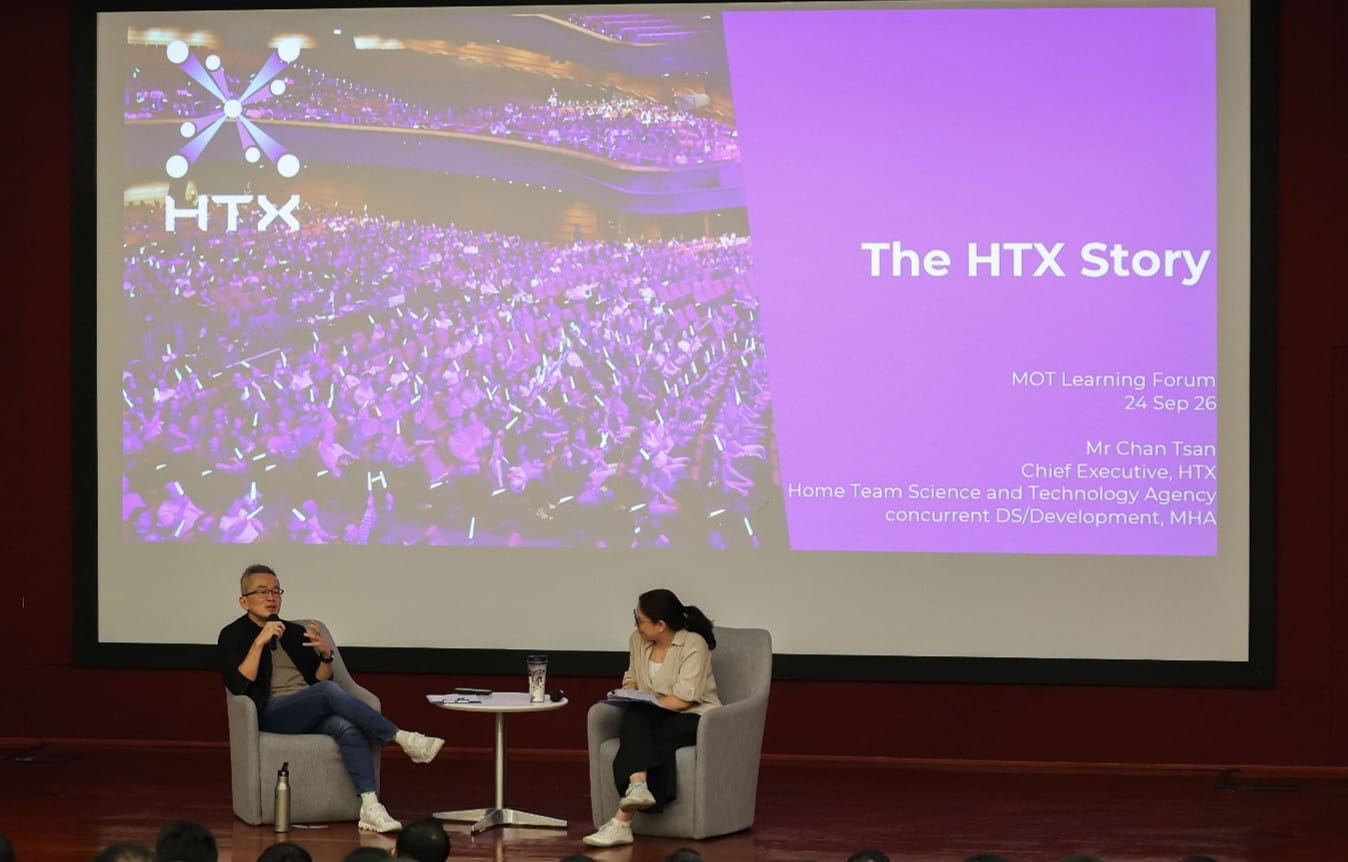
 HTX Chief Executive Chan Tsan speaking at the Ministry of Transport Learning Forum. (Photo: HTX/Isabelle Lee)
- On 24 September, HTX Chief Executive Chan Tsan spoke to over 100 officers from across the Ministry of Transport (MOT) at the MOT Learning Forum.
- He shared how HTX has transformed the Home Team’s S&T ecosystem by strengthening in-house capabilities, becoming a smarter buyer, builder and sustainer of technology and growing a talented STEM workforce.
- HTX’s approach combines experimentation, systems integration and co-development with partners, reflected in projects including passport-less immigration clearance.
- HTX is investing in future capabilities such as humanoid robotics, while continuing to nurture the people and culture needed to sustain transformation.
Public safety and public transport are two sectors that operate complex, interdependent systems, whereby slight missteps can cause outsized knock-on effects. Transformation must therefore be undergirded by reliability and anchored on a culture of innovation that drives a motivated STEM workforce.
This was one of the key messages in the address by HTX Chief Executive (CE) Chan Tsan at the Ministry of Transport (MOT) Learning Forum on 24 September, during which he shared insights into what it takes to build a future-ready public service agency through the lens of HTX’s transformation journey.
The session drew over 100 officers from across MOT divisions and statutory boards.
Reflecting on HTX’s formation in 2019 to transform the wider Home Team S&T ecosystem, Tsan highlighted a backdrop of evolving public safety challenges that have inspired ambitious ideas such as passport-less immigration clearance.
“We came to the realisation that if we did not transform the way we delivered science and tech in the Home Team, we weren’t going to be able to realise those big dreams that we had,” he said.
 HTX CE Chan Tsan fielding questions during the Q&A session. (Photo: HTX/Isabelle Lee)
He framed HTX’s overarching transformation strategy around a three-step approach: innovate with the problem in mind, deliver by being a smarter buyer and builder, and sustain capabilities efficiently after deployment.
“Be very clear of what is the problem you’re trying to solve, but be very, very open-minded about the solution,” said Tsan, who cited the cyborg cockroach project as an example of how HTX pursued an unconventional solution to search-and-rescue operations.
He also noted that a common albatross weighing down public service agencies is the protracted procurement process. Prior to HTX’s formation, Home Team departments procured turnkey tech solutions that could take years to deliver and risked becoming outdated by the time they went live. These solutions were often fragmented, contributing to a ballooning tech footprint that was increasingly hard to maintain.
To achieve better outcomes, HTX is focusing on in-house innovation and integrated delivery wherever it makes sense. This agility was clearly demonstrated in the New Clearance Concept (NCC) passport-less immigration clearance project, where HTX broke its problem statement into different components, brought together specialised teams and vendors, and stewarded programme management plus systems integration.
The payoff was significant: most travellers to Singapore can now use passport-less clearance, which has significantly reduced processing times.
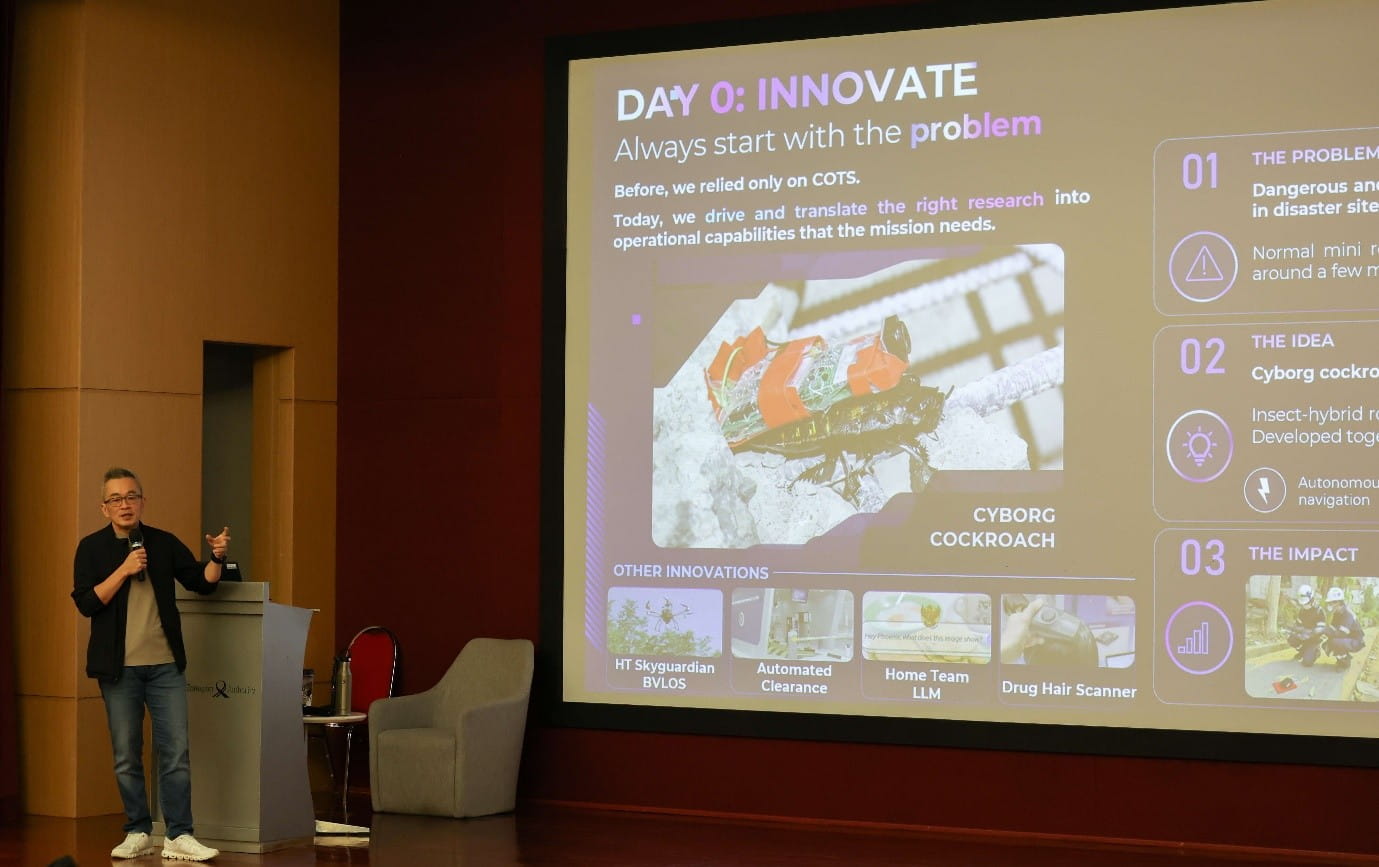 CE Chan Tsan shared on HTX’s various tech innovations. (Photo: HTX/Isabelle Lee)
But becoming a smarter builder also meant strengthening the digital foundations of such systems. HTX thus created a common enterprise architecture to better facilitate in-house development and secure data flow across systems. Its sovereign AI stack spans Graphics Processing Units (GPUs), AI models and applications, including Teammate, the Home Team’s in-house AI chatbot designed to support sensitive use cases.
Tsan also stressed that sustainment is just as important as innovation and delivery.
“Business as usual is very critical in the Home Team context. In fact, it’s a beautiful thing. Because when citizens call 995 or 999, they want it to work,” he said.
He then pointed to the Home Team Sustainment Centre, which centrally monitors a wide range of Home Team assets – from vessels and vehicles to buildings, systems and endpoints – to prevent operational disruptions.
 CE Chan Tsan shared insights gleaned from HTX’s transformation journey. (HTX/Isabelle Lee)
Looking ahead, Tsan shared that there are more future-proofing projects in the pipeline, from training humanoid robots for Home Team missions to supporting increasingly technology-intensive developments closely connected to MOT – including the upcoming Johor Bahru-Singapore Rapid Transit System (RTS) Link.
He noted that HTX would also share its know-how, capabilities and innovation networks with other agencies as the public safety technology Centre of Excellence (CentEx) for the Whole-of-Government (WOG).
Yet, technology is only part of the equation. Tsan stressed that enduring transformation also depends on cultivating the right talent and culture.
“The workplace culture has to be one where engineers feel that they can grow and have fun doing what they do,” he said.