
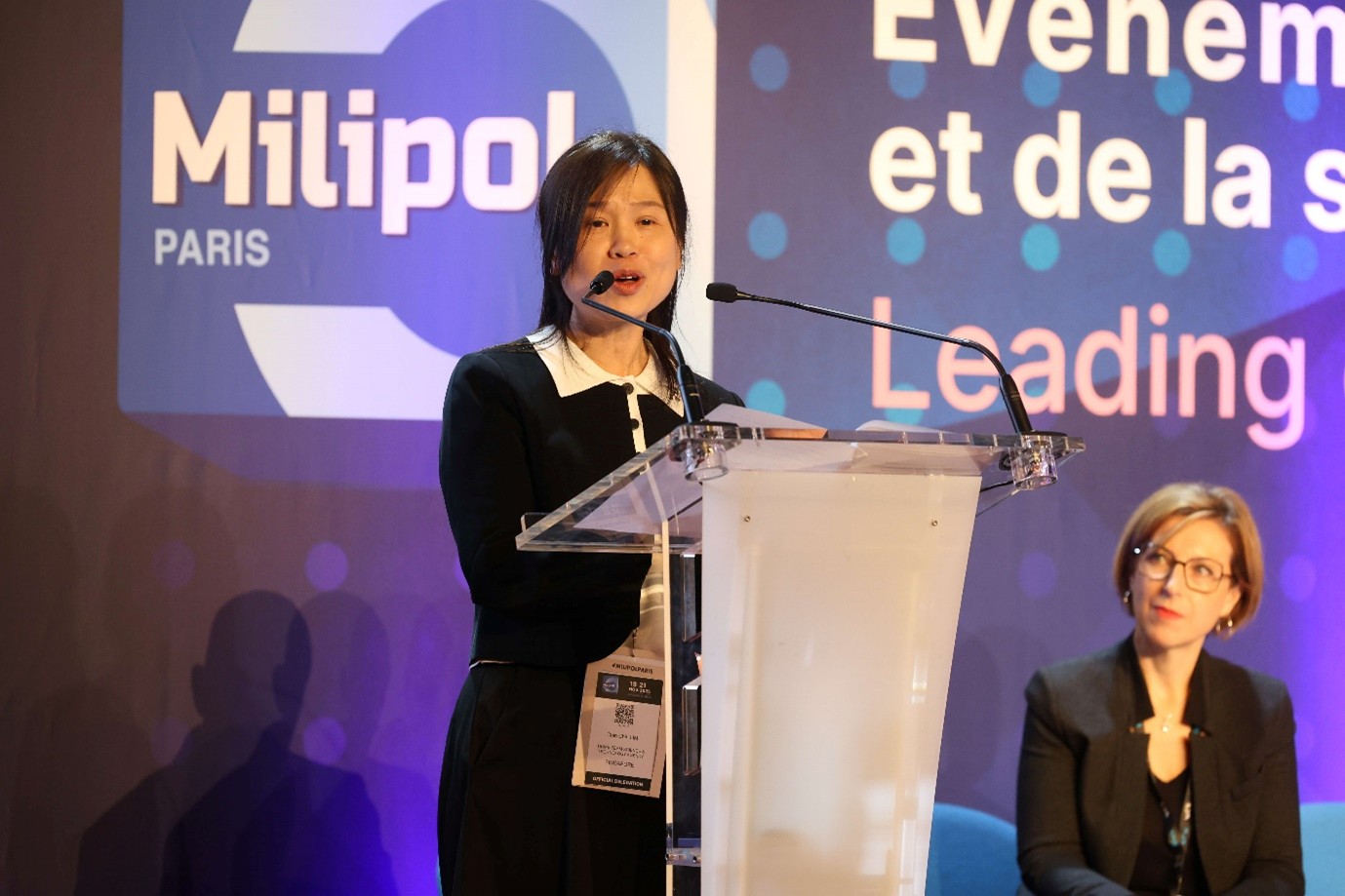
 ACE (Science) Lim Chin Chin delivering her keynote address at Milipol Paris 2025. (Photo: HTX/Jasline Tan)
Forensic science is on the cusp of a profound transformation – and artificial intelligence (AI) will be central to that journey. That was the overarching message delivered by Lim Chin Chin, HTX’s Assistant Chief Executive (Science) and Director of the Forensics Centre of Expertise (CoE), during her keynote address at Milipol Paris 2025 on 19 November.
With more than three decades of experience in the field under her belt, Chin Chin shed light on how HTX is redefining the future of forensic science through AI.
She pointed out that the HTX Forensics CoE had started embracing generative AI (GenAI) even before it gained traction globally in 2023. Even then, the challenges were formidable. Chief among them was the lack of sufficient data to train models.
To address this, the team curated open-source datasets, generated synthetic data such as tens of thousands of fingerprint images and, most importantly, built the Forensic Innovation and Research for Strategic Transformation (FIRST) laboratory. Launched on 14 April 2025, the lab boasts a digitally-enabled environment designed to generate, aggregate and validate forensic data securely.
Chin Chin said that the use of AI to collect, analyse and document evidence more efficiently will be important because the volume and complexity of data produced by modern instruments – such as advanced DNA sequencing – are rapidly increasing.
However, she acknowledged that the adoption of AI in forensics globally has been cautious, explaining that forensic science operates in a space where precision, transparency and legal scrutiny are non-negotiable. AI systems must not only be accurate, but also explainable and understandable to non-experts, including judges and juries. The consequences of error can be profound.
Beyond technical hurdles, Chin Chin identified the biggest challenge as cultural, noting that forensics experts must be bold enough to leave behind the workflows of old and embrace new ones built around AI.
“We must change our mindset completely,” she emphasised.
At the intersection of science and innovation
Still, she reiterated that AI is a tool, not a replacement for human expertise. The forensic scientist of the future will work in synergy with AI: allowing it to handle laborious tasks while applying human judgement to interpret results and make decisions in dynamic, real-world situations. Workflows, job roles and training must evolve accordingly.
Such transformation cannot happen in isolation, she added. HTX’s AI movement – supported by Singapore’s national AI strategy and robust governance frameworks – equips officers with AI literacy and cultivates an “AI-first” mindset.
Chin Chin also called for global collaboration to develop standards, validate models and strengthen trust in AI-assisted forensic practices across the entire chain of justice.
In closing, Lim issued a challenge to the international community: to be bold, to innovate responsibly, and to seize the opportunity to shape the future of forensic science before malicious actors cause harm.
AI is transforming society, she reminded the audience – and forensic science must not fall behind.