
- HTX worked closely with the Singapore Civil Defence Force (SCDF) to implement SG Alert, Singapore’s new mass warning system for deployment during emergencies such as major fires, chemical or terror incidents.
- Powered by cell broadcast technology, it enhances Singapore’s emergency communications framework with secure, fast and reliable mobile outreach.
- Behind the scenes, HTX engineers engaged with multiple stakeholders to ensure multilingual alerts can be delivered reliably across different devices.
- The project underscored the importance of balancing technical limitations, operational requirements and multi-stakeholder coordination in delivering critical public safety technologies.
Come May 10, users connected to the Singtel network can expect a pop-up notification, unique alert tone and vibration pattern on their mobile phones that will last for up to 10 seconds – even if their phones are set to silent or “Do Not Disturb” mode.
If you happen to receive this notification, fret not – you haven’t been hacked – it’s just the Singapore Civil Defence Force (SCDF) conducting island-wide testing of the new SG Alert mass emergency warning system, which was launched in partnership with HTX, the Infocomm Media Development Authority (IMDA) and Singtel.
Contrary to popular imagination, deploying such systems involves more than a minion pushing a button in an obscure back room.
Kenny Kang, a Lead Engineer at the Civil Defence Programme Management Centre (CDPMC) can attest to that, having worked with multiple stakeholders to ensure the smooth delivery of SG Alert.
“This is the first time such a large-scale cell broadcast system is being implemented in Singapore, and we’ve gained a lot of knowledge of how it works on a practical level,” he shared. “We initially assumed that it was purely about setting up the infrastructure but were surprised by the complexity of overseeing various moving parts.”
CBS’s advantage
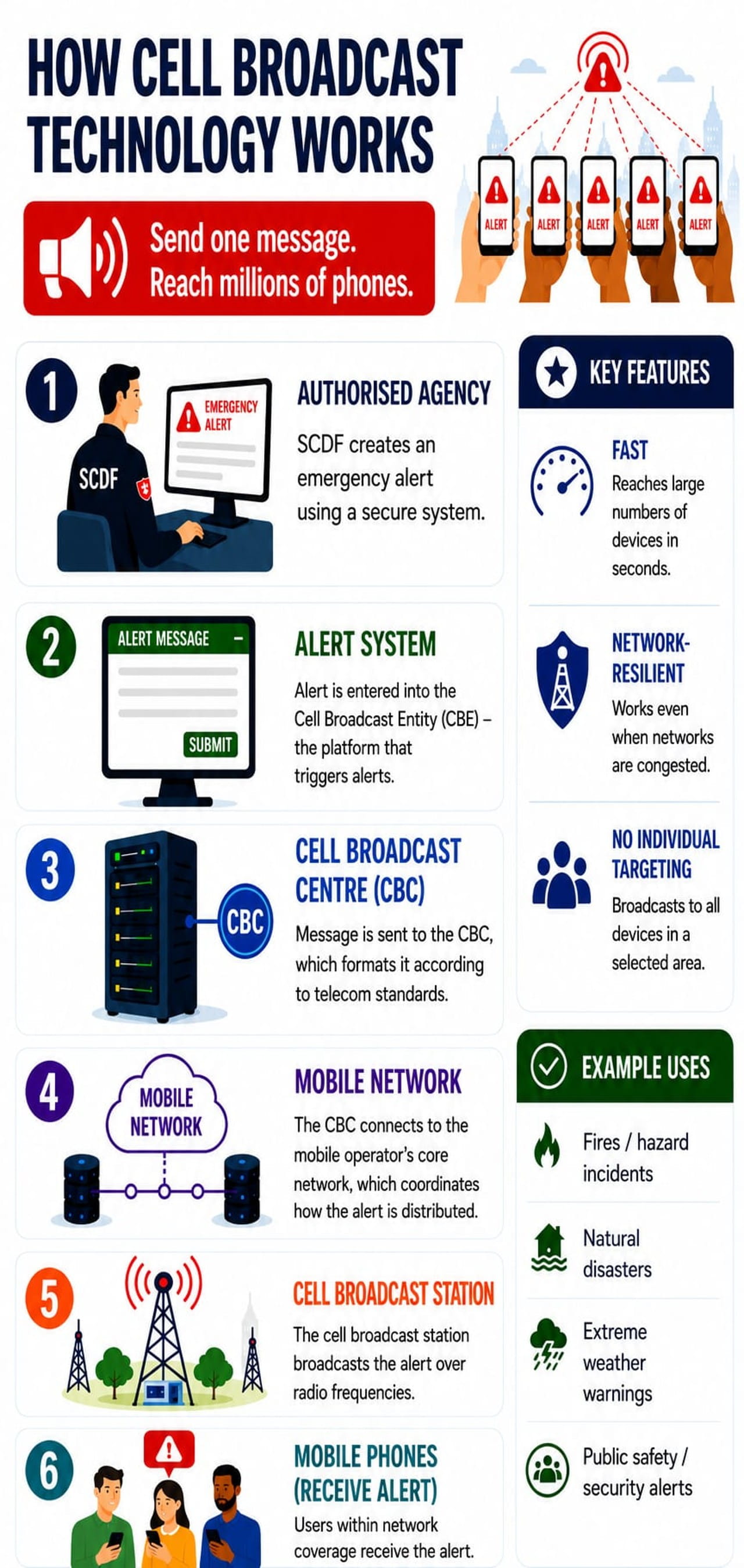
The tech behind SG Alert is known as cell broadcast technology (CBS), which delivers messages without requiring mobile data or collecting personal information. Unlike SMS, which sends messages to individual numbers, cell broadcast works as a one-to-many transmission to all compatible mobile phones, either within a specific geographical zone or nationwide.
“Cell broadcast technology uses the radio network rather than Internet-based mobile data services, so it is not affected by congestion from multiple messages,” explained Kenny.
These alerts are designed to override a mobile phone’s silent or “Do Not Disturb” mode – behaviour specified in international standards set by the 3rd Generation Partnership Project (3GPP), which mandate the delivery of highest-level emergency alerts regardless of user settings.
 (Infographic: HTX)
Together with colleagues from Enterprise Communications and Digital Infrastructure (xCDI), Kenny and team began implementing the system in early 2025, when they first engaged Apple and Google to align on SCDF’s operational requirements, including support for disseminating alerts in Singapore’s four main languages (English, Chinese, Malay and Tamil).
This proved to be quite the challenge as the language filtering mechanisms – whereby each mobile phone automatically displays only a primary and secondary language based on the users’ preferred language – did not work on certain devices due to Cell Broadcast Centre (CBC) configuration issues.
To address this issue, the team worked closely with Apple, Google and Singtel to align on the technical standards governing how multilingual cell broadcast alerts are encoded, transmitted and interpreted across the networks and devices.
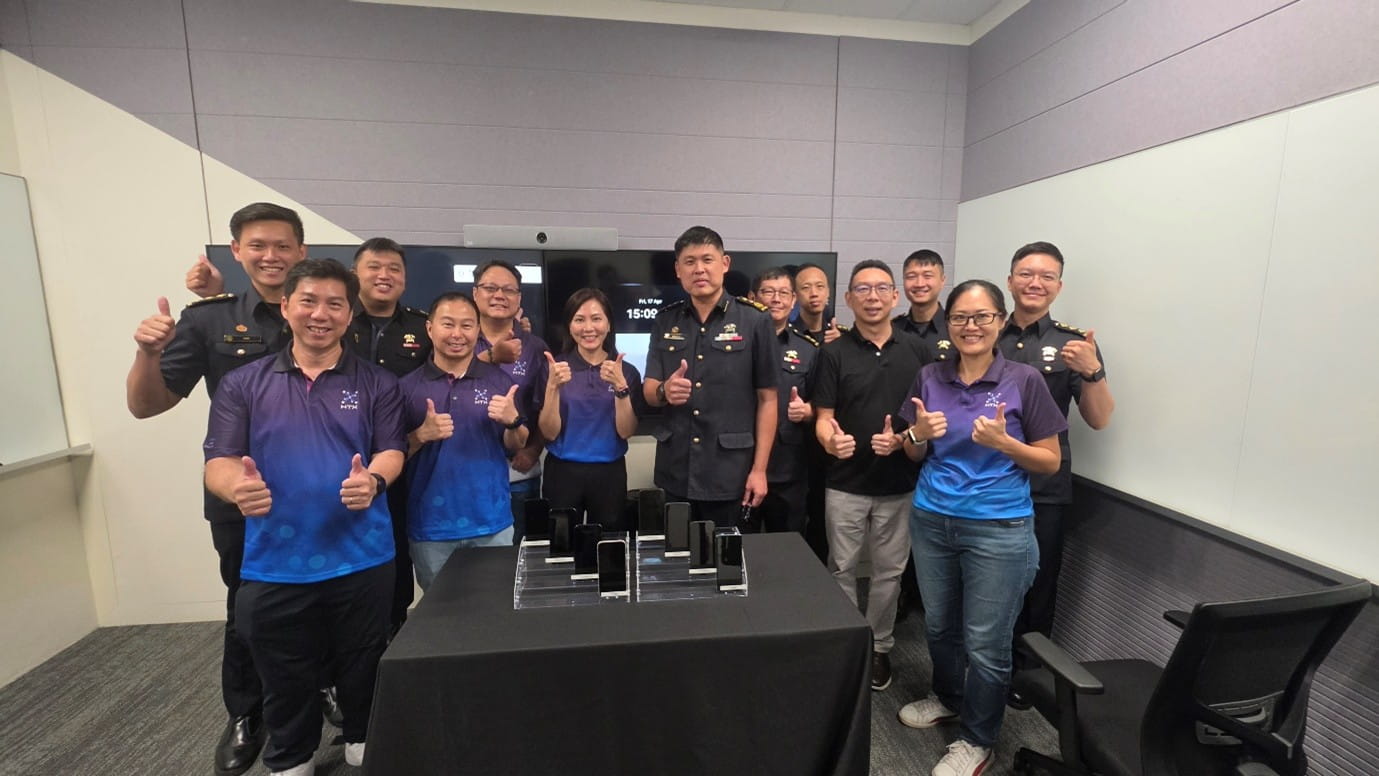 The CDPMC and xCDI teams with their counterparts from SCDF. (Photo: HTX/CDPMC)
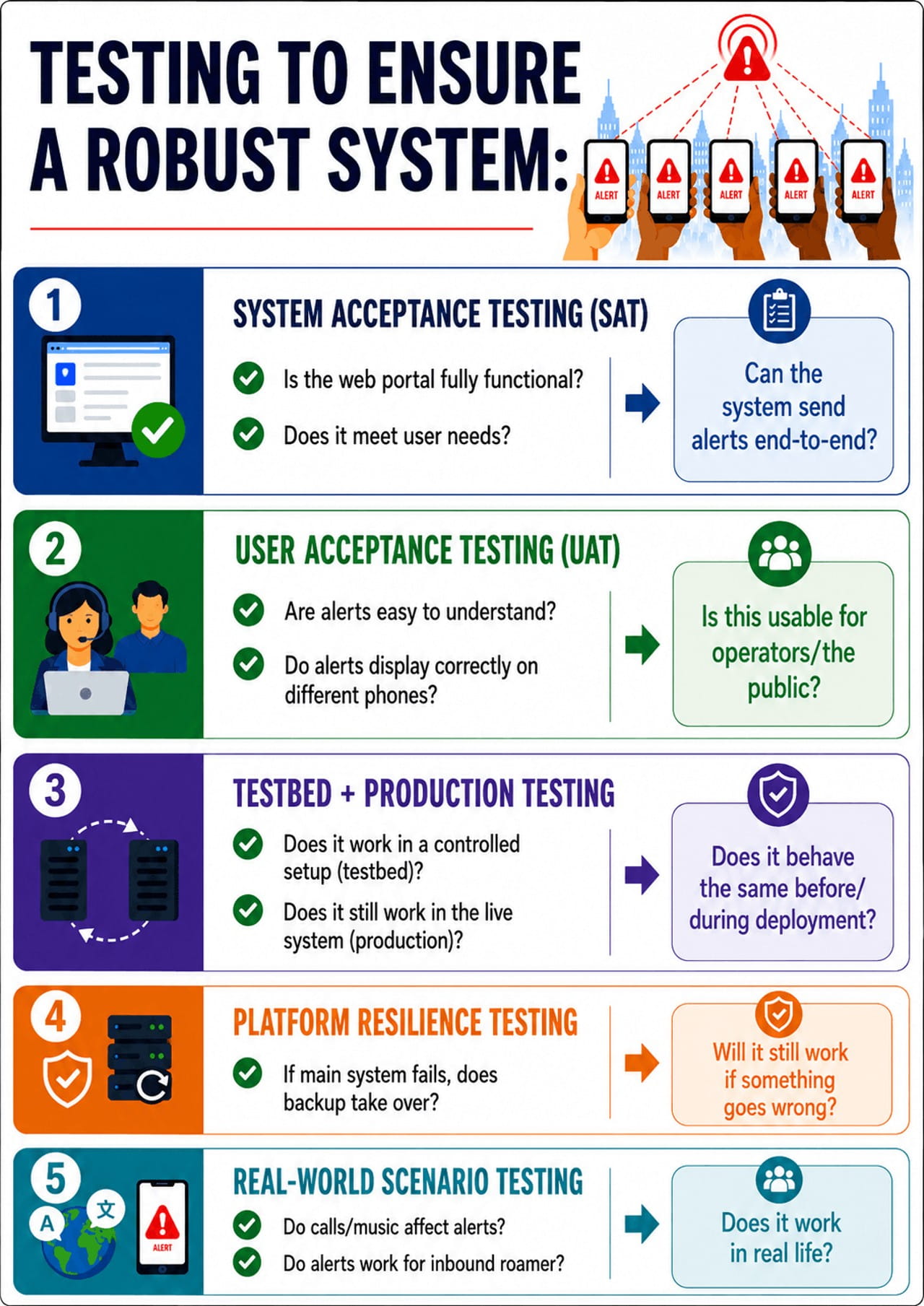
They then worked in an iterative cycle: conducting tests across multiple stages and hosting environments to validate reliability under real-world conditions, gathering and analysing the results. After several rounds of rigorous testing and adjustments, all parties involved aligned on the same standards, and the alerts began displaying correctly on different mobile phones.
 (Infographic: HTX)
According to Kenny, this was an exercise in tenacity that paid off, but his team’s work doesn’t end here. In the lead-up to the 10 May islandwide test, CDPMC is focusing on several key steps to ensure everything runs smoothly.
First, they are working with SCDF to finalise the official alert message in all languages before it’s uploaded onto the system.
At the same time, they are coordinating with Singtel to verify that the network is fully operational, while conducting internal test runs to check that the system works end-to-end across different mobile phone brands and settings.
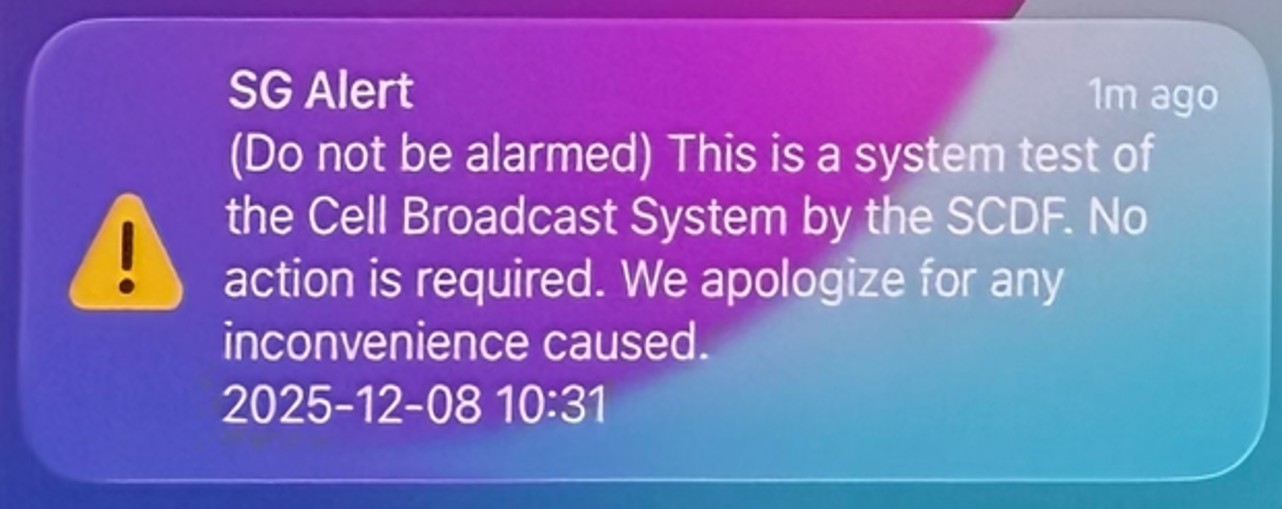 A snapshot of what users may see on their mobile phones during the islandwide test of the SG Alert national warning system. (Photo: HTX)
Even once all systems are go, Kenny and his team must contend with delivery unpredictability, as performance may vary across software versions. But in a project rife with variables, they’ve gleaned important lessons in negotiating unforeseen circumstances.
It was, for all intents and purposes, a delicate balancing act of managing expectations by articulating the technical limitations while meeting both tight timelines and SCDF’s requirements.
“As the bridge between the technical and operational stakeholders, it’s all about prioritisation and clear communication,” concluded Kenny.
Ultimately, working behind the scenes has been rewarding, said Kenny, who noted that their efforts directly enhance SCDF's capability to deliver alerts quickly and reliably in life-threatening emergencies – where every second counts.