- HTX recently launched Phoenix-VL 1.5 Medium in collaboration with Mistral AI. It’s the Home Team’s most advanced sovereign AI model built with Singapore at its core.
- The first in-house developed AI model to deliver multimodal and broader multilingual capabilities, it is fluent in multiple local and regional languages commonly used in Singapore.
- It combines Singapore knowledge with frontier-level intelligence, offering multimodal intelligence comparable to leading global AI systems.
- Phoenix-VL 1.5 Medium has been deployed across the Home Team ecosystem and will continue to be enhanced for future iterations.
Ask any AI model a question about Singapore and you’ll find that only one answers with information that’s intricately shaped by Singapore’s laws, culture and landscape: Phoenix, the Home Team’s first family of fully sovereign AI models.
Developed by HTX in collaboration with Mistral AI, Phoenix is among the first models in Singapore to be built with the nation and the Home Team at its core.
It represents a significant step forward in line with the agency’s HTxAI Movement, and its pursuit of sovereign AI.
In April 2026, HTX unveiled the most advanced model of the family to date – also the Home Team’s flagship multimodal and multilingual AI model – at the Asia Pacific’s leading public safety event, MTX (Milipol TechX Summit) 2026.
Meet Phoenix-VL 1.5 Medium
 (Image: HTX/Team Phoenix)
Locally grounded, globally capable
Commercial and open-source AI models aren’t usually trained to understand a specific country. That’s what makes Phoenix so different – it’s intimately familiar with Singapore, and can speak the country’s four main languages.
Continually pre-trained on Singapore-focused data, it can understand the country’s policies, legislation, culture and Home Team terminology, which allows it to provide safer, more grounded and contextually aware responses for actual operational uses.
By owning and operating its own AI systems for the Home Team, HTX also strengthens Singapore’s long-term strategic independence by growing local AI capability and reducing reliance on overseas providers.
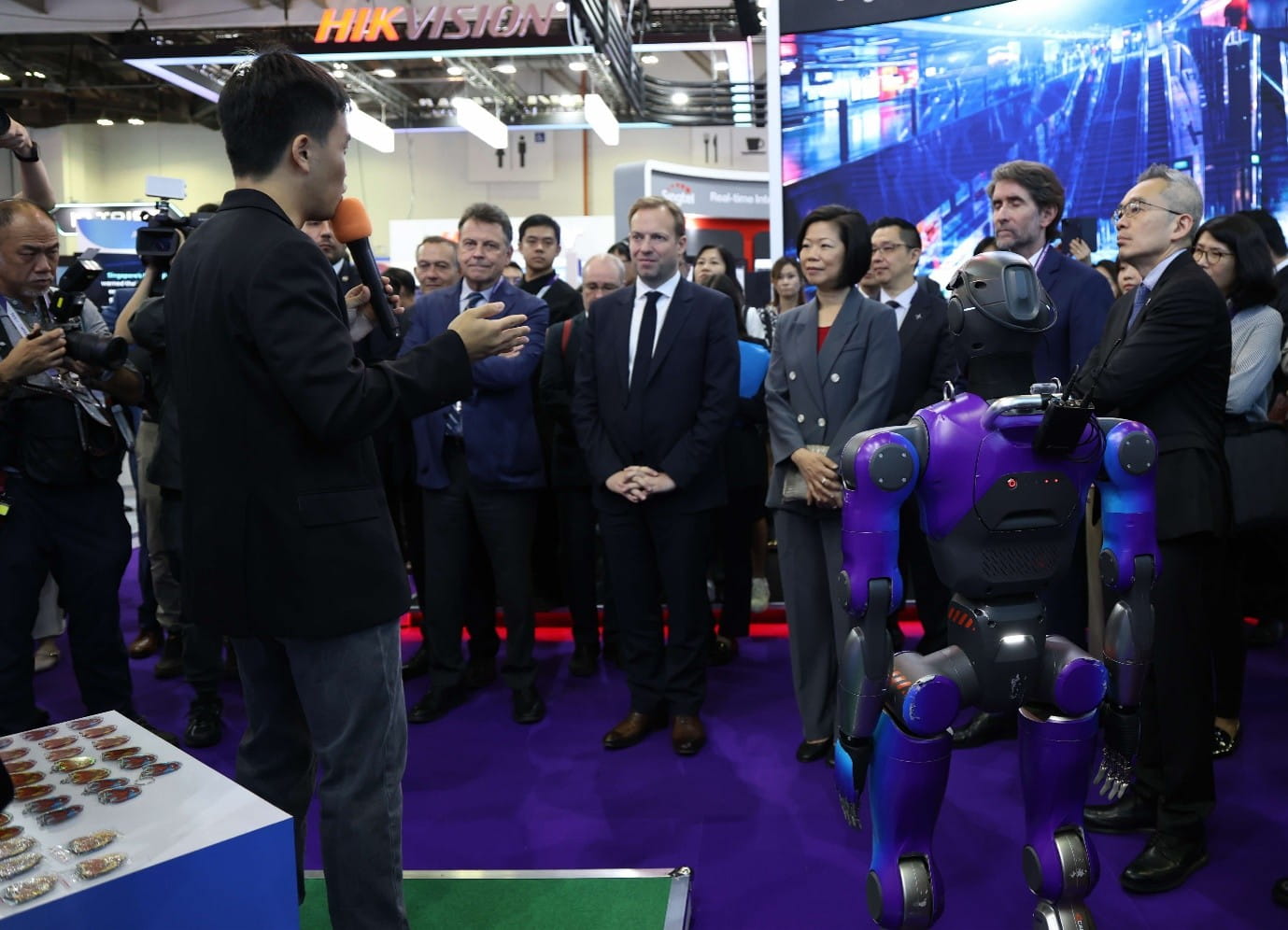 Team Phoenix’s Technical Lead Wang Jiale (presenting) officially unveils Phoenix-VL 1.5 Medium at MTX 2026, loaded as embodied AI into a humanoid robot. (Photo: HTX/Nicole Lim)
The most impressive part? Phoenix’s local focus doesn’t come at the expense of broader intelligence.
Phoenix-VL 1.5 Medium, in particular, isn’t just good at Singapore-specific tasks; it excels at general intelligence too. It can reason and solve complex general problems at a level comparable to leading global frontier AI systems.
Built on a base Mistral Medium 3.1 model and powered by 123 billion parameters – the largest in Singapore’s public safety context – it expands on the 24-billion parameter Phoenix 1.0 Small model released earlier this year, delivering stronger performance in general knowledge, coding, mathematics and multilingual capabilities, and for the first time, introducing multimodal AI.
In other words, this latest version has gone far beyond simply recognising and processing text. It can now analyse images in detail, perform Optical Character Recognition (OCR), reason across charts and tables, and even interpret multiple frames extracted from videos.
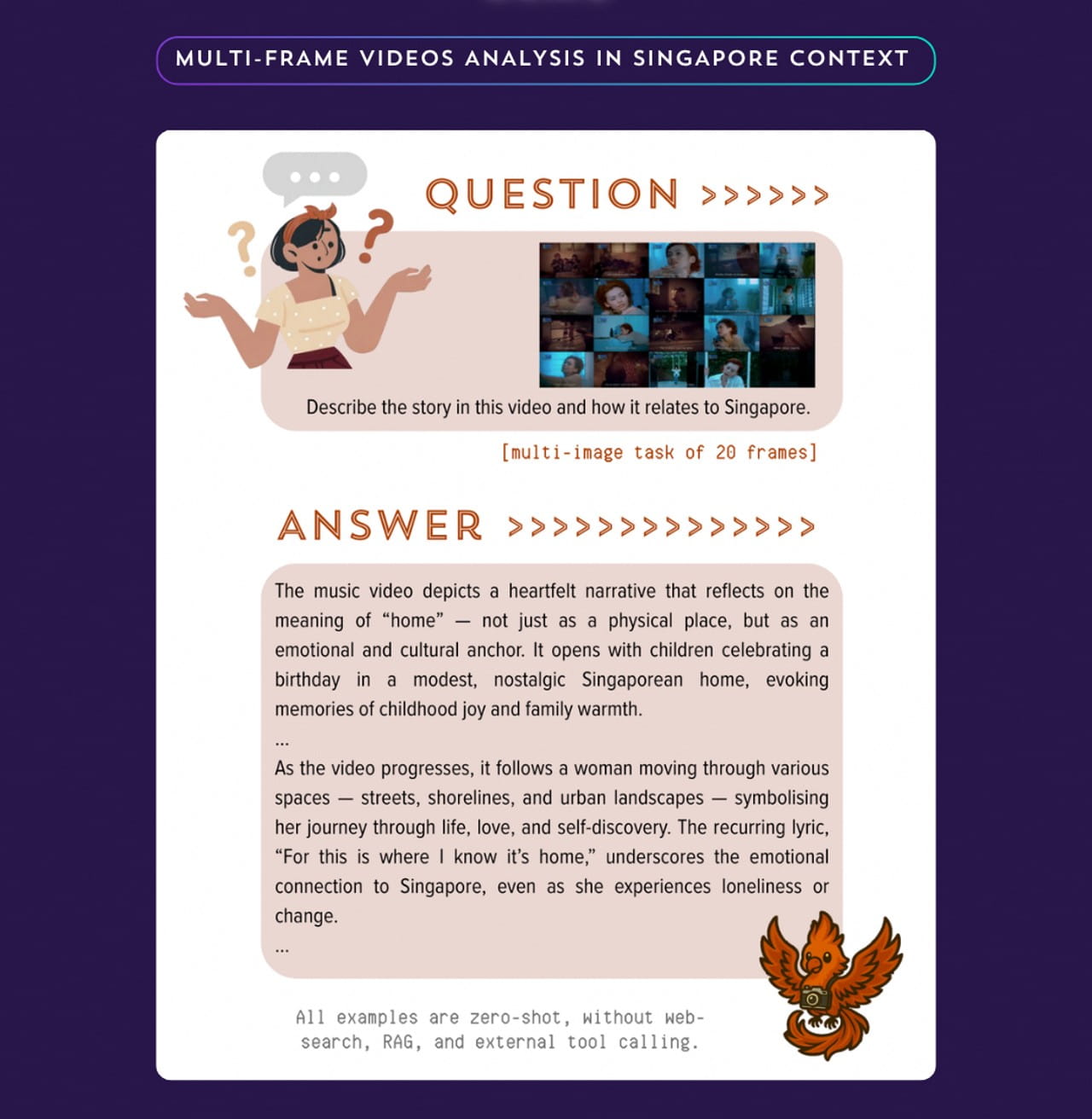 An example of Phoenix-VL 1.5 Medium analysing video content with its multimodal capabilities. (Image: HTX/Team Phoenix)
What’s more, the model can comprehend documents containing multiple languages. That’s right, Phoenix-VL 1.5 Medium isn’t just fluent in English, but also in the main languages spoken in Singapore – Mandarin, Malay and Tamil – and of course, our colloquial Singlish.
It can even process regional Southeast Asian languages like Bahasa Indonesia and Thai.
Why is this necessary? Well, real-world communications aren’t necessarily set in English only. In the Home Team’s operations, conversations, reports or even evidence could be multilingual or culturally nuanced.
Bigger, smarter, stronger
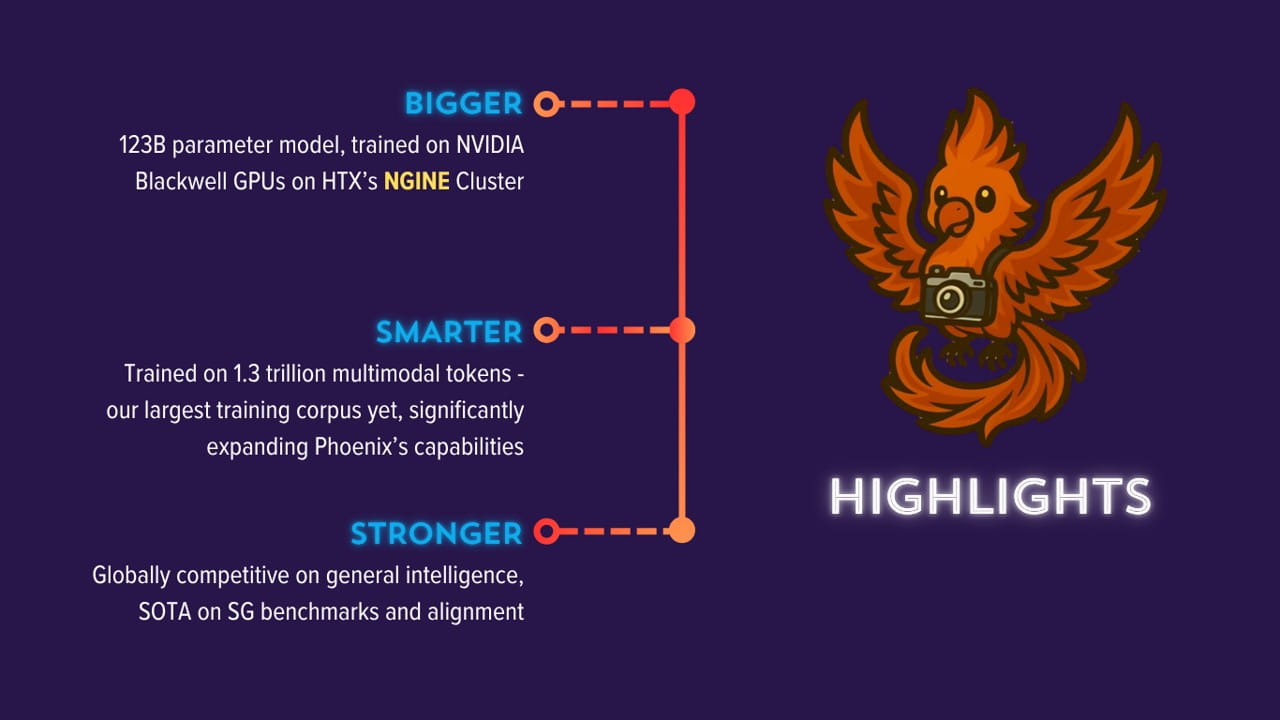 A snapshot of Phoenix-VL 1.5 Medium’s characteristics. (Image: HTX/Team Phoenix)
Phoenix wasn’t born with the ability to talk about Singapore’s statutes, or to discern between laksa and Hokkien mee, right off the bat. Building a transformative AI system doesn’t happen overnight.
Team Phoenix’s Technical Product Manager, Dr Yeo Shun Yi, explains that it took several highly complex and calculated steps to achieve “a deliberate progression from early experimentation to a production-grade, sovereign AI system – one that’s built for secure and real operational use”.
Behind the scenes, technical steps went into the nitty-gritty to ensure top-notch quality and safety, such as by using data quality classifiers to retain the highest-quality data, increasing representation of essential or underrepresented examples through a process called “up-sampling”, and filtering out undesirable or harmful content (can’t have Phoenix analysing any #NSFW topics now, can we?).
And central to the development process is the model’s air-gapped and controlled deployment environment.
Unlike many AI systems today, Phoenix is designed to operate without open internet access or Retrieval-Augmented Generation (RAG), meaning it does not pull information from external sources in real time to produce an answer. Instead, it internalises regional knowledge directly within its weights.
This doesn’t just improve security by reducing exposure of the Home Team’s sensitive data to external systems – it also increases the accuracy and reliability of its responses.
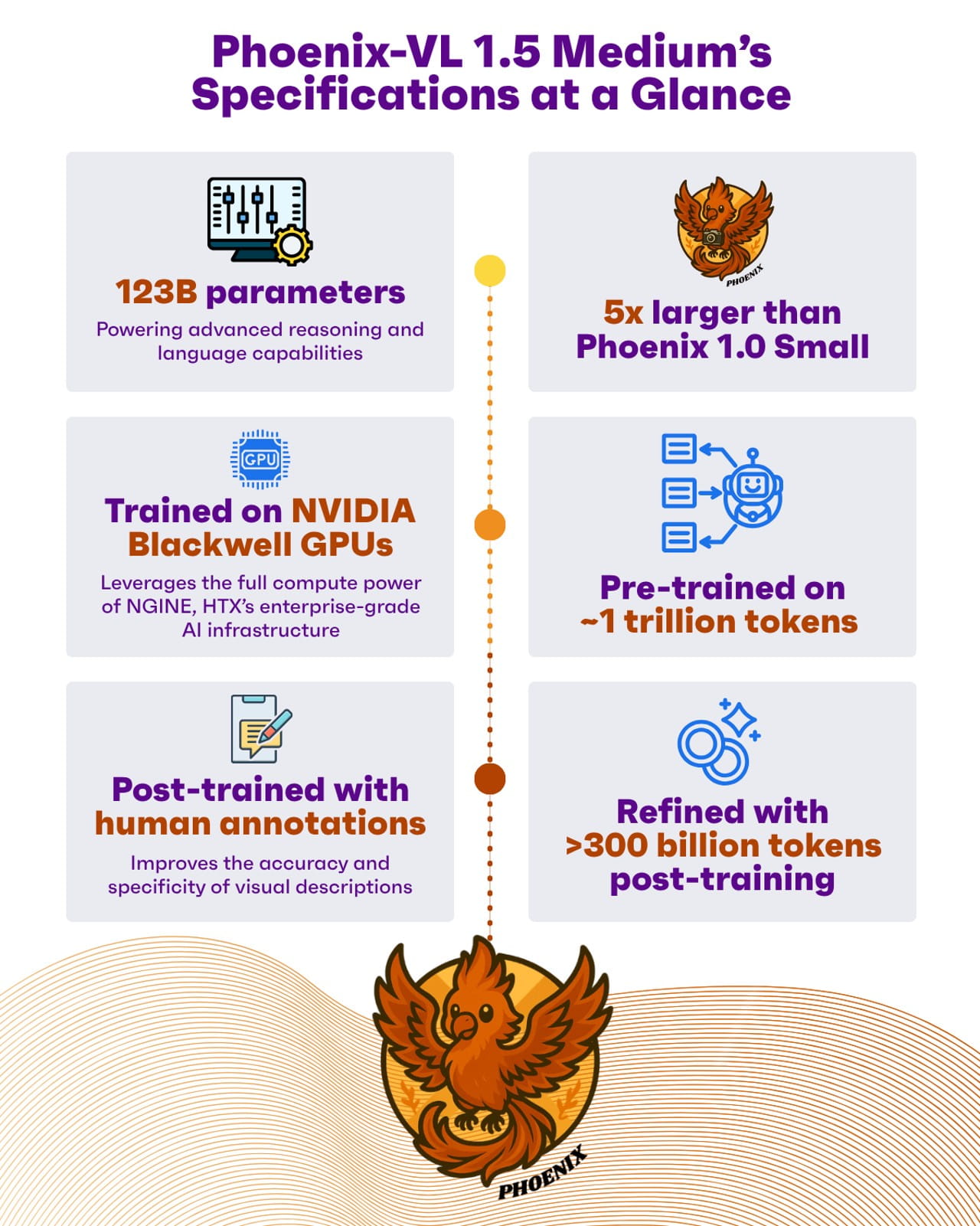 (Image: HTX/Nicole Lim)
The development of Phoenix-VL 1.5 Medium didn’t stop right after pre-training, or simply feeding the model large amounts of inputs to learn from.
According to Dr Yeo, heavy efforts were also invested in post-training – like employing trained personnel to teach the model what responses are preferred – to adapt it into “a usable, safe and task-specific system that can produce outputs appropriate for real-world situations”.
“Post-training was crucial for domain adaptation – where the model learned local laws, agency terminology and workflows – but also for safety alignment, ensuring it avoids hallucinations, sensitive data leakage, or inappropriate responses in high-stakes environments,” she expounded.
The team also created its own novel Model Behaviour and Safety Framework, to ensure the system is grounded in Singapore’s statutory laws with minimal hallucinations, blocks harmful multimodal tasks, and acknowledges limitations instead of providing misleading or overly agreeable answers.
So, whenever unsure, it would honestly say, “I don’t know”, instead of providing incorrect responses confidently.
So, how good is Phoenix really?
According to Team Phoenix’s evaluations, the latest model has proven to be smart – really smart – in both local and broad-spectrum contexts.
Not only does it excel in Singapore-specific knowledge, it also delivers state-of-the-art performance in general multimodal intelligence, multilingual understanding and coding – at levels comparable to commercial AI models of similar size.
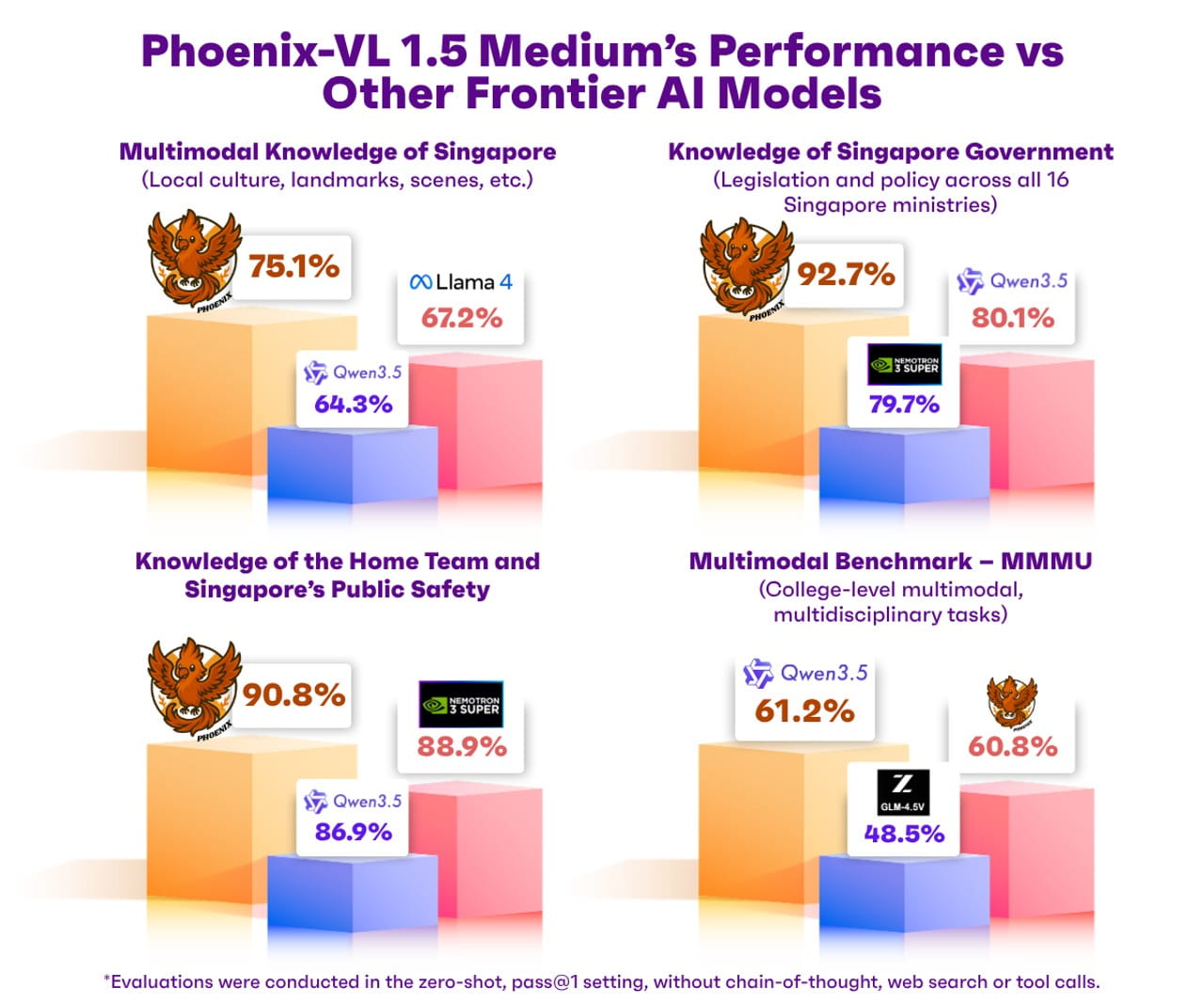 (Image: HTX/Nicole Lim)
Intelligence in action
Like Marvel’s Infinity Stones, powerful AI models are ultimately defined by how they are used.
Since its launch in late April, Phoenix-VL 1.5 Medium has already processed millions of tokens through its deployment in the Home Team’s internal chatbot platform, Teammate, and received thousands of Application Programming Interface (API) calls by Home Team developers.
It has been able to answer highly specialised queries such as:
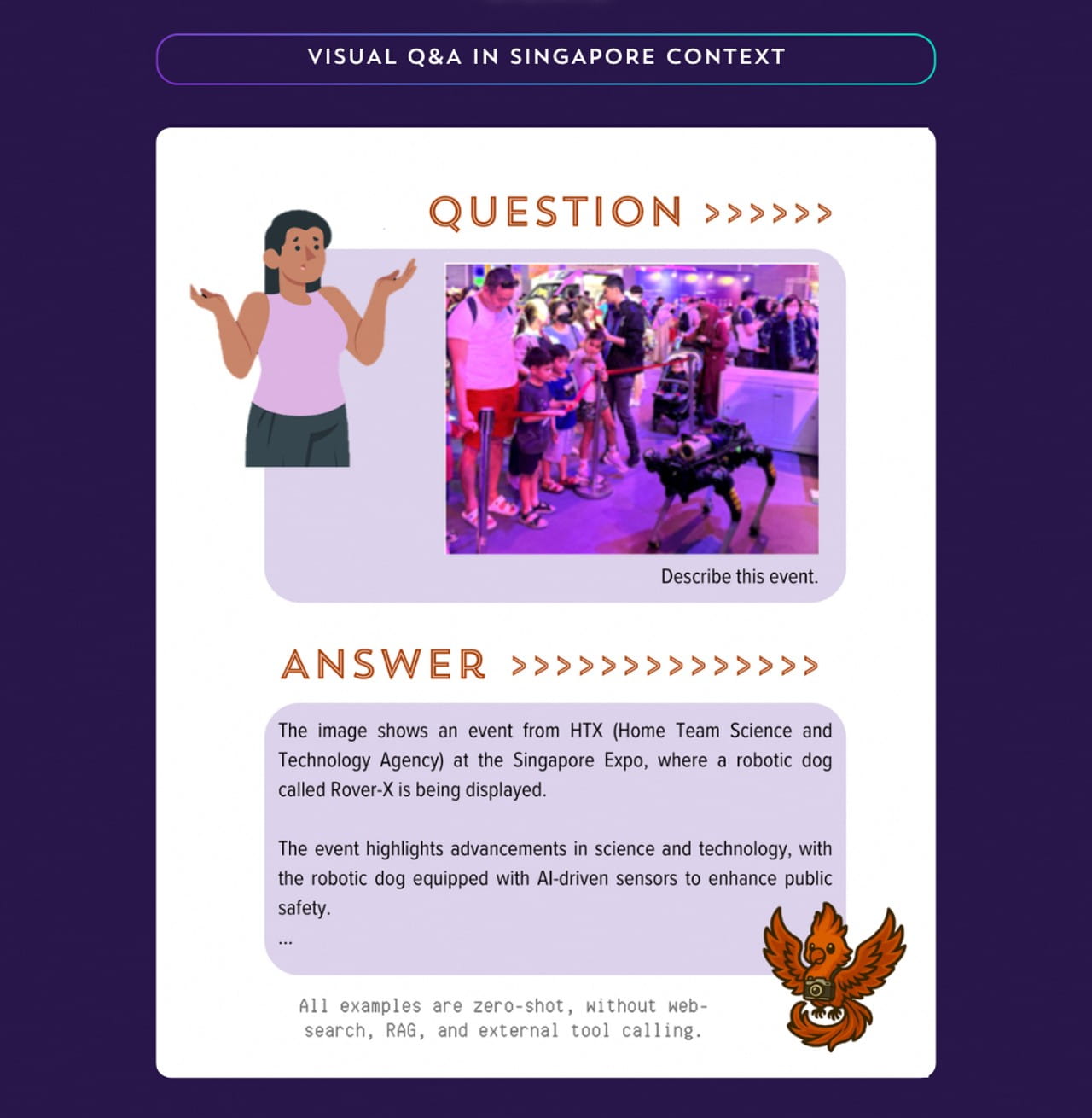 Phoenix can understand real-world scenes, incidents and infrastructure within the Singapore context, such as publicly-known equipment used by public service agencies. (Image: HTX/Team Phoenix)
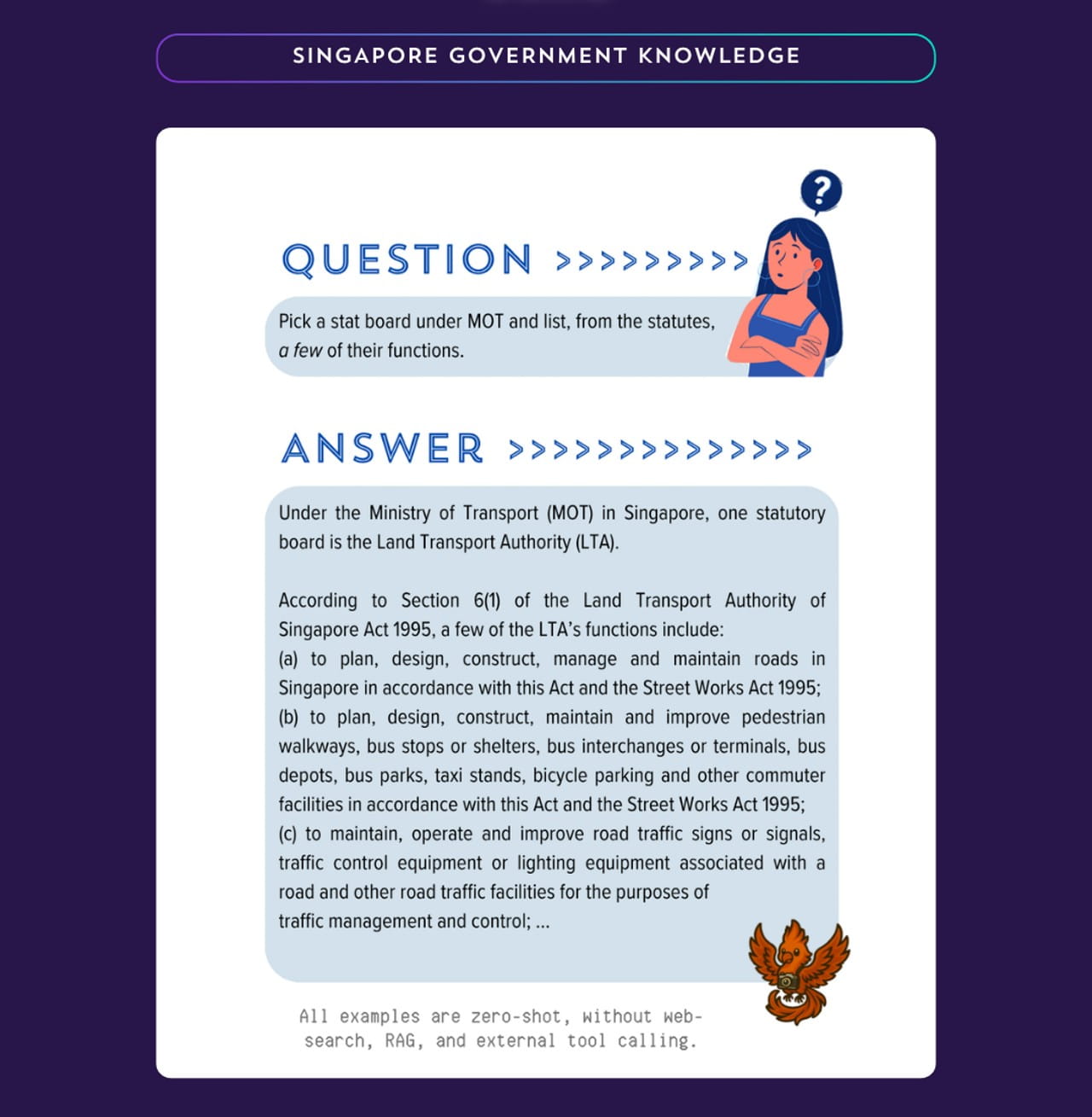 Its understanding of Singapore governance and legislation is the strongest in its class. (Image: HTX/Team Phoenix)
Beyond chatbots, Team Phoenix is also working closely with HTX’s Centres of Expertise to explore applications in embodied AI for public safety uses, such as in powering autonomous humanoid robots that could one day support Home Team officers in dull, dirty and dangerous operational tasks.
The team will continue to develop more advanced multimodal systems within the family, with deeper integration into the Home Team’s operations to safeguard the nation.
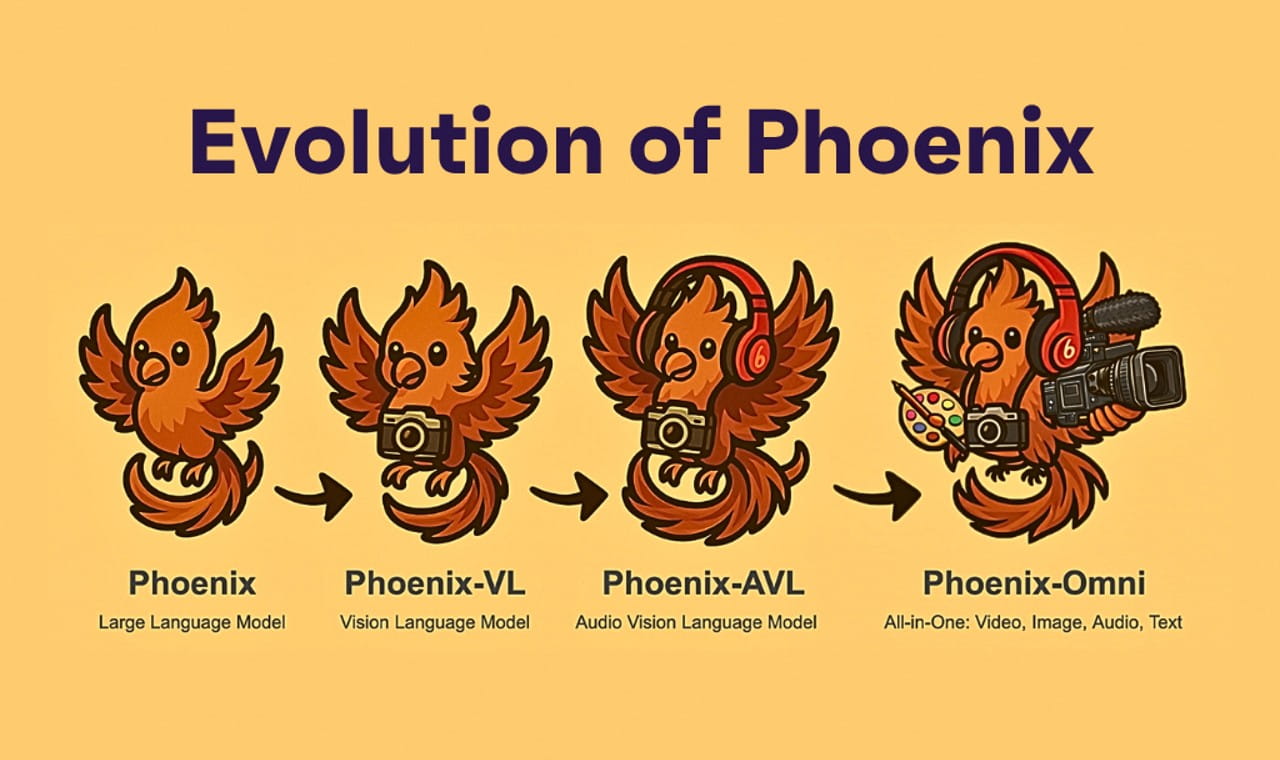 The eventual destination? Phoenix-Omni: a strategic "stretch goal" for multi-modality. This aims to integrate text, image, video and audio reasoning, combining transformer-based models with diffusion models to enable generative outputs across different media. (Image: HTX/Team Phoenix)
While possibilities sound promising, Team Phoenix’s Dr Yeo emphasised that the models are designed to support human judgment and decision-making, not replace it.
“Outputs are intended to accelerate work, not finalise decisions, and should be treated as draft assistance within a human-in-the-loop workflow, as like all other AI systems, errors or misinterpretations can still occur,” she explained.
The growth trajectory of Phoenix, she added, isn’t just about scaling the systems.
“It’s also about ensuring that they remain trusted, secure and contextually aligned with the Home Team’s evolving needs,” she said.
Want to learn more about Phoenix-VL 1.5 Medium? Read the full technical report on how Team Phoenix built the model now: